
THANK YOU FOR SUBSCRIBING
Startup City: Specials Magazine
DSC INVESTMENT
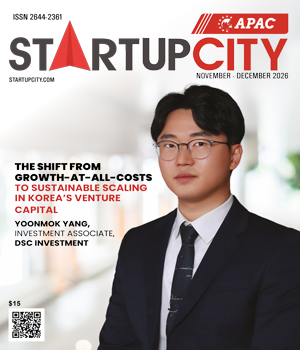
The Shift from Growth-At-All-costs to Sustainable Scaling in Korea's Venture Capital
Yoonmok Yang is a venture capitalist and Investment Associate at DSC Investment, with prior experience at Bain & Company and Hyundai Motor Company. He specializes in AI, venture funding and strategic growth. A KAIST graduate, he actively invests in startups, focusing on emerging technologies and global market expansion. Through this article, Yang emphasizes the resilience of Korea’s venture capital and startup ecosystem, highlighting the role of government policy funds in sustaining investment and underscoring the shift towards scalable, revenue-generating business models as the key to long-term success. The Korean venture capital and startup ecosystem has displayed a relatively resilient trajectory, even as global capital markets face persistent headwinds. A key driver of this resilience is a series of government-led policy funds, which have expanded significantly and compensated for the reduction in private capital contributions. Official figures indicate that venture investment size in Korea grew by around 9.5 percent from the previous year, reaching almost 9 billion USD, contrasting sharply with stagnant or marginally negative growth in other major markets. While this uptick underscores the country’s commitment to fostering entrepreneurship, it also reflects the Korean government’s determination to bolster early-stage and growth-stage financing through a more robust policy framework. “Projections for 2025 suggest that the Korean stock market could increase, fueled by expectations of global interest rate cuts and an ongoing recovery in the semiconductor sector. This would naturally lead to a more favorable environment for companies seeking to go public” Nevertheless, the overall ecosystem has not been immune to challenges. Early-stage investments—especially in ‘seed to series A rounds’—have declined by nearly 30 percent in terms of deal count and about 25 percent in aggregate deal value. This trend suggests that despite an overall ri
Robotics
Edge-based AIoT technology is shaping the future of connected environments by enabling local data processing, streamlining decision-making and enhancing user control. MySmaX is at the forefront of this transformation with its service-centric AIoT platform, JOI, and a JOI-installed edge device, called JOI Hub. The solution securely manages communications and interactions between various devices, transforming complex device-specific management into service-centric automation. “Building the JOI AIoT platform around edge computing has enabled us to create a truly secure, reliable and user-centered smart platform,” says Soonhoi Ha, CEO. MySmaX primarily caters to smart commercial and industrial spaces, high-trust environments and homeowners. Factories, farms, warehouses and offices experience scalable automation that streamlines operations, optimizes resource use and reduces downtime. In high-trust environments where critical infrastructure is held to stringent data privacy and reliability requirements, JOI ensures that sensitive information remains local and devices operate securely. It equips residential properties with intuitive automation across lighting, climate, security and robotic services, without technical complexity. JOI stands apart by delivering absolute convenience, built-in security and future-ready flexibility, all within one intelligent platform. Users simply need to describe what they need, and it seamlessly coordinates devices without the hassle of multiple apps or compatibility issues. Operating at the edge, it ensures privacy and resilience even if one device is compromised. When clients scale, it adapts dynamically and integrates any device or service into the network. These capabilities make it not just smart but intuitively designed for real-world impact. Its technology reduces the risk of interception during data transmission. Devices communicate exclusively through the secure middleware, which authenticates commands and blocks unauthorized access, giving users complete control over their environment. They can define automation scenarios, select compatible devices and decide what data leaves their premises. Privacy and control are pre-integrated. JOI routes all device communications through a local server, enabling real-time behavioral monitoring. Using AI-driven anomaly detection, it analyzes device activity against established behavioral baselines. Any suspicious activity, like conflicting signals or abnormal patterns, is instantly identified, isolated and reported to the user, preventing lateral spread and preserving system integrity.

Japanese Biotech Startups

International trade has always been a grand stage where nations exchange goods, ideas, culture, and opportunity. However, behind this spectacle lies a complicated backstage. Exporters chase customs officers with stacks of forms. Importers watch anxiously as documents crawl through email threads. Banks, insurers, and logistics companies juggle phone calls and spreadsheets, often struggling to sync. The system functions with difficulty, consuming significant time and resources. That’s where TradeWaltz has emerged as a model for how public–private partnerships (PPPs) can transform global trade. Established in 2020 through a joint initiative of 18 of Japan’s leading corporations, including NTT Data Corporation, Toyota Tsusho Corporation, Mitsubishi Corporation, Sumitomo Corporation, and MUFG Bank, Ltd., the company represents PPP backed by the Ministry of Economy, Trade and Industry (METI). “Our goal is to build Japan’s national digital infrastructure for trade and extend that framework across borders through secure, standardized data exchange,” says Takahiro Sato, president and CEO. Building Japan’s Trade DX Infrastructure To achieve this, TradeWaltz provides a blockchain-powered SaaS platform that connects and allows all participants to share information with required parties instantly on a single, trusted network. This eliminates the dependence on emails, faxes, and redundant document entries, allowing data to flow instantly and securely between stakeholders. TradeWaltz’s approach: Standardization → Digitization → Visualization → Streamlining → Efficiency has already set the de facto standard for trade digitalization in Japan. Working with FUJIFILM Logistics and Hankyu Hanshin Express, TradeWaltz reduced process time by 47 percent through automation. Similarly, for Japanese exporters trading with Indonesia, the platform enables direct digital submission of shipping documents and customs data into Indonesia’s system, replacing paper-based processes with real-time, cross-border data flow.
Singapore Startups

How To Cope With Covid19 Market Meltdown
Patricia Poon, Founder & Managing Partner, Belmond Capital Limited
Japanese Biotech Startups

Promising Signs for a Resurgent Tech Ecosystem in Japan
Shun Nagao, Venture Partner, White Star Capital
Japanese Biotech Startups

A New Era of AI-Driven Seafaring
Niklas Holck, Founder & CEO, Tradeworks.vc and Shail Barthwal, Founder & CEO, Nexus Ocean AI
Japanese Biotech Startups

Beyond Returns, Building Southeast Asia's Next Gen Ventures
Krit Phanratanamala, Managing Director, Bualuang Ventures
Japanese Biotech Startups

Talent Boom for Start-Ups!?
Jordan Green, President Emeritus/Founder, Melbourne Angels Inc

IN MY OPINION
Japanese Biotech Startups
Shaping The Future of Innovation and Venture Capital
John Lim, Partner, Meet Ventures

LAST WORD
BioTech Startups
Why Venture Capitalists Always Negotiate Valuations Even When They Seem Reasonable
Johnny Yu, Managing Director, Mosaic Venture Lab
IN FOCUS

AIoT Startups Shaping APAC's Smart City Transformation
APAC's Smart City revolution is driven by AIoT startups that address urban challenges through innovations in mobility, resource management, and public safety, enhancing sustainability and quality of life.

APAC's Tech Startups: Mastering Global Market Dynamics
APAC startups succeed globally by prioritizing localization, strategic partnerships, flexible models, compliance, and digital-first strategies while balancing innovation and cultural sensitivity.
EDITORIAL
Building Resilience in a Changing Startup Landscape
The startup ecosystem continues to evolve as founders, investors and business leaders navigate changing market conditions, emerging technologies and shifting growth expectations. In the region, it is now common for companies to focus on creating an environment where innovation can coexist with efficiency. As companies seek new opportunities, flexibility, profitability and sustainability are the key criteria for success.
In this edition of Startup City APAC, we explore the trends shaping the future of entrepreneurship and venture growth. Founders are placing greater focus on market validation, efficient execution and sustainable expansion, while investors are becoming more selective in identifying opportunities with strong fundamentals. At the same time, advances in digital technologies continue to create new pathways for innovation across industries.
Technology has continued to play a significant role in enabling growth; however, it goes beyond just offering better tools. Companies have become more concerned with using technology in their decision making process and enhancing productivity. The ability to be more responsive in business is also being leveraged through the use of technology, making it easier for startups to respond.
Another important shift is the growing focus on resilience. Business leaders are recognizing that long-term success depends not only on pursuing growth but also on building organizations capable of adapting to changing customer needs, competitive pressures and economic realities. This mindset is encouraging a more balanced approach to innovation, investment and execution across the startup ecosystem.
As the startup landscape continues to mature, strong leadership, informed decision-making and a commitment to continuous improvement will remain essential. The organizations shaping the future understand that lasting impact is created through a combination of vision, execution and adaptability.
We invite readers to explore the insights and perspectives shared in this issue and gain a deeper understanding of the opportunities and challenges influencing today's startup ecosystem.
